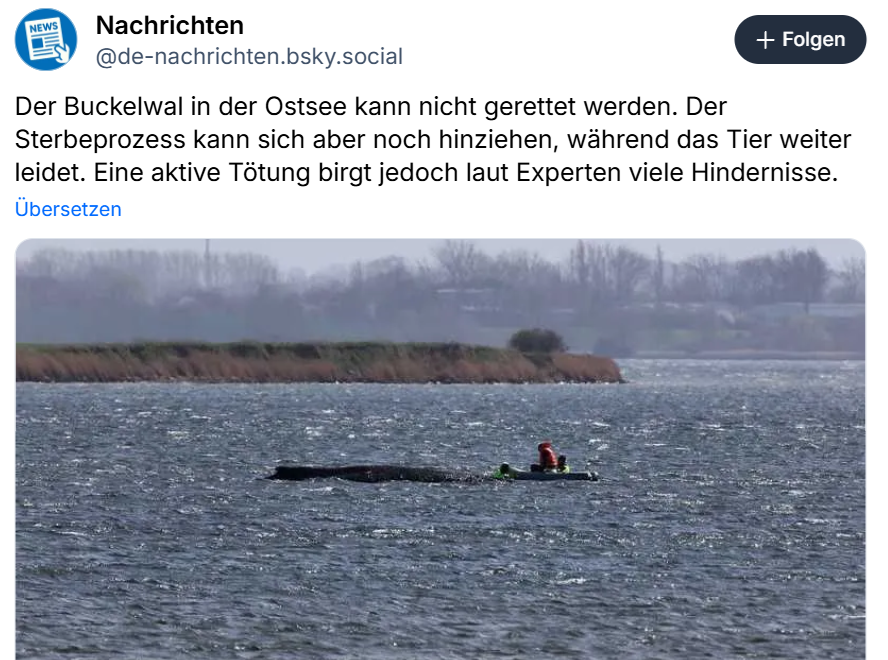
Impossible Rescue: Why Stranded Humpbacks Cannot Be Saved in the Baltic
The majestic humpback whale (
Megaptera novaeangliae) is a creature of the open ocean, renowned for its acrobatic breaches and haunting songs. Yet, occasionally, these giants of the deep make a catastrophic navigational error, venturing from the vast Atlantic into the confines of the Baltic Sea. When a humpback, weakened and disoriented, strands itself on a shallow sandbank in this enclosed brackish environment, it often marks the beginning of an impossible rescue mission, leading inevitably to a tragic conclusion: the *Buckelwal Ostsee Tot*. Despite immense public concern and dedicated efforts by experts, the sheer scale of these animals combined with the unique challenges of the Baltic Sea makes a successful intervention virtually unattainable. The story of "Timmy," a young humpback that recently captured headlines after repeated strandings, serves as a poignant reminder of this harsh reality.
The Lure of the Baltic: A Deceptive Trap for Humpbacks
Why do these magnificent cetaceans find themselves in such peril? The journey of a humpback into the Baltic Sea typically begins as a pursuit of prey. Following nutrient-rich "North Sea water bubbles" filled with schools of herring or other delicious bounty, whales can inadvertently navigate through the Danish straits and into the Baltic. For a whale accustomed to the vastness of the ocean, the Baltic's geography presents a profound challenge. It's a semi-enclosed sea, characterized by a unique ecosystem of lower salinity and weak tidal currents, especially compared to the dynamic Atlantic.
Once inside, the whales’ sophisticated navigation systems, finely tuned for oceanic currents and deep-sea contours, seem to fail them. Atlantic whales simply "have no concept" for escaping the Baltic trap. With their food source rarely turning back, there's little immediate incentive for the whale to reverse course. As they push further east, often into increasingly shallow and unfamiliar waters, their disorientation grows. The low salinity can also stress their bodies, adapted for the saltier ocean. The repeated stranding of a whale like Timmy, who managed to free himself only to get stuck again further east (initially near Timmendorfer Strand, then off Wismar, and later off Poel), is a clear indicator of a creature that is both weakened and profoundly lost. Efforts to guide them are often futile, as boats generate noise and stress, further exacerbating their disoriented state. This environmental mismatch, coupled with the whales' struggle to navigate, sets the stage for the grim reality of the
Baltic Sea Whale Trap: Understanding Why Humpbacks Get Stranded and Die.
The Herculean Challenge: Why Large Whale Rescues Fail
When marine mammals strand, public empathy rightly swells, and the desire to help is immense. However, the scale of a humpback whale makes rescue attempts virtually impossible. While smaller marine mammals, such as the porpoises (up to 1.8 meters) that inhabit German coastal waters, can sometimes be saved, the same cannot be said for their colossal cousins. Experienced stranding teams in places like New Zealand and Australia, often dealing with pilot whale strandings, have developed sophisticated methods: keeping animals wet, carefully lifting them with specialized mats, or waiting for the tide. These smaller whales can sometimes be gently guided back to deeper waters, though re-stranding remains a risk, and euthanasia is sometimes necessary.
For a humpback, which can weigh up to 40 tons and measure over 15 meters, such methods are utterly impractical. Human rescuers simply lack the brute force to lift or move an animal of this magnitude. Furthermore, using sufficiently strong mechanical equipment, like heavy machinery, risks causing severe internal and external injuries to the whale, compounding its suffering rather than alleviating it. The immense body of a stranded humpback also creates a powerful suction effect with the sandy seabed, effectively gluing it in place. Even the most advanced and dedicated stranding teams worldwide lack the capacity or equipment to safely rescue such a massive marine mammal.
Experts from the Institute for Terrestrial and Aquatic Wildlife Research (ITAW) and Greenpeace, along with local authorities, have often explored every conceivable option. In Timmy's case, they waited for the Baltic’s notoriously weak tidal currents to provide enough lift, but the minimal rise in water level was insufficient. Attempts to dig a channel with an excavator might seem logical, but even this can be too disruptive and, as experience shows, often fails to dislodge such an immense, suctioned body. The consensus among global experts is stark: for a creature of this size, once truly stranded, the outcome is almost invariably fatal, leading to the unfortunate *Buckelwal Ostsee Tot*.
Signs of Distress and the Inevitable Outcome
A whale repeatedly stranding itself, struggling in shallow waters, and swimming further into the enclosed Baltic are all dire signs. These behaviors indicate a deeply stressed, disoriented, and often weakened animal. A healthy humpback would possess the strength and navigational acumen to avoid such predicaments or, if briefly caught, to free itself swiftly. The fact that a whale like Timmy found temporary freedom only to become re-stranded signals a critical decline in its health and mental state.
When a large whale is in this condition, it faces immense physiological challenges. The prolonged exposure out of deep water puts extreme pressure on its internal organs, and its massive body can overheat even in cool temperatures. Without constant movement in the water, it cannot effectively filter feed or regulate its body temperature. The consensus among biologists and veterinarians observing such events is overwhelmingly grim. The creature is suffering, and while the desire to intervene is strong, the most humane, albeit heartbreaking, conclusion is that nature must take its course. The unfortunate reality is that the public witnesses the slow, unavoidable decline of the animal, highlighting
The Tragic Fate of Timmy: Why Humpback Whales Die in the Baltic Sea.
It's also crucial to address the misinformation that can arise during such high-profile events. The environmental ministry in Mecklenburg-Vorpommern, for instance, had to issue warnings against fake donation calls circulating on social media platforms like TikTok during Timmy's ordeal. While public sympathy is genuine, it's important to rely on official channels and expert guidance to avoid falling victim to fraudulent schemes.
Beyond Rescue: What Can We Learn and Do?
While direct rescue for a stranded humpback in the Baltic is a near impossibility, these unfortunate events offer vital lessons and underscore the importance of ongoing conservation efforts.
1.
Expert Monitoring and Data Collection: Organizations like ITAW and Greenpeace play a crucial role in monitoring these animals, gathering data, and advising authorities. This information is critical for understanding whale behavior, migration patterns, and the impacts of human activity on marine life. Their expertise ensures that all feasible, humane actions are considered, even if a direct rescue isn't one of them.
2.
Public Awareness and Respect: When a whale strands, the best thing the public can do is keep a respectful distance and avoid causing further stress to the animal. Reporting sightings to official marine wildlife authorities immediately is paramount, rather than attempting private interventions. Disturbing the whale, or gathering too closely, can exacerbate its distress and hinder expert assessment.
3.
Global Conservation Efforts: The most effective way to protect humpback whales is through robust conservation efforts in their native habitats. This includes measures to reduce ship strikes, mitigate ocean noise, combat pollution, and prevent entanglements in fishing gear – factors that weaken and disorient whales even before they might wander into the Baltic. Understanding the broader threats helps prevent future "misnavigations" that lead to such tragic outcomes.
4.
Addressing the Baltic's Health: While the Baltic isn't an ideal habitat for humpbacks, its overall ecological health is vital for the species that do call it home. Efforts to reduce nutrient runoff, mitigate chemical pollution, and protect vital breeding grounds for species like herring can create a healthier ecosystem for all marine life.
Conclusion
The sight of a stranded humpback whale in the Baltic Sea is a profoundly sad and helpless situation. Despite the universal desire to save such magnificent creatures, the realities of their immense size, their weakened state, and the unique challenges of the Baltic environment render direct rescue efforts futile. The fate of these misplaced giants, like Timmy, serves as a stark reminder of nature's power and fragility, leading inevitably to the *Buckelwal Ostsee Tot*. While we cannot change the tragic outcome of individual strandings, we can learn from them, support the dedicated experts who monitor these events, and intensify our efforts to protect marine ecosystems globally, ensuring that fewer whales face such an unfortunate end.